
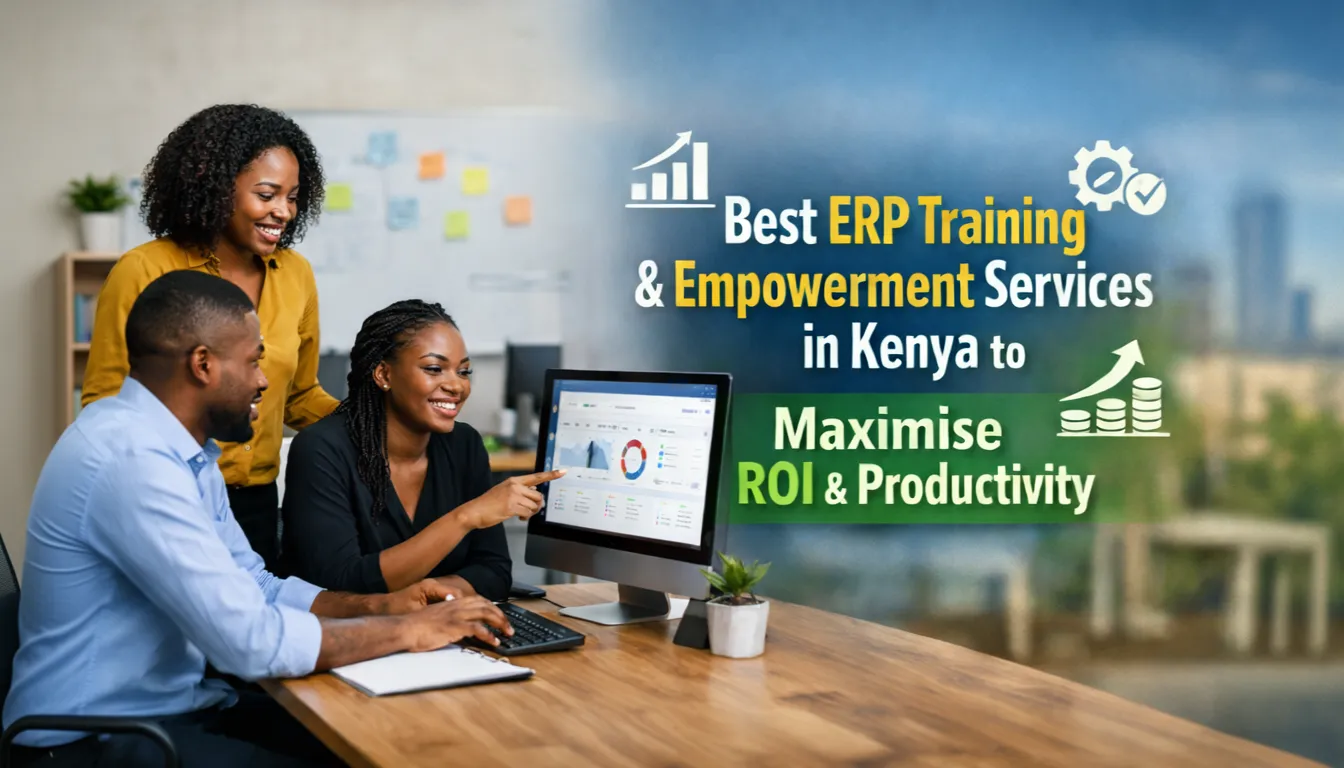
Most businesses don’t fail with ERP because of the system itself. They struggle because their people never fully adopt it. Teams hesitate, processes stay half-manual, and suddenly that “powerful system” becomes just another tool sitting underused.
That’s where ERP Training & Empowerment Services in Kenya start to make a real difference. It’s not about ticking a training box. It’s about making sure your team actually understands how to use ERP in their everyday work — confidently, consistently, and without second-guessing every step.
Why ERP Training Matters More Than You Think
It’s Not Just About Learning the System
A lot of companies assume training means showing users how to navigate screens. But ERP isn’t just software — it’s deeply tied to your business processes.
Without proper understanding, teams often:
- Use workarounds instead of following processes
- Enter incorrect or incomplete data
- Avoid using certain features altogether
And that’s where things quietly break down.
Poor Training Leads to Hidden Costs
You won’t always see the damage immediately. But over time, it shows up as:
- Delayed reports
- Inaccurate data
- Reduced productivity
- Frustrated employees
So while ERP itself promises efficiency, poor training can quietly cancel those benefits out.
What Are ERP Training & Empowerment Services?
Fundamentally, the goal of ERP Training & Empowerment Services is to assist users in becoming system owners rather than merely learners.
It’s about building confidence.
Instead of memorising steps, users understand:
- Why processes exist
- How their role connects to the bigger picture
- What to do when something goes wrong
That shift — from usage to ownership — is what makes ERP truly effective.
Key Components of Effective ERP Training
Role-Based ERP User Training Programs
Not everyone uses ERP the same way. A finance manager’s needs are completely different from someone in inventory or sales.
Training tailored to roles ensures:
- Relevance
- Faster learning
- Better retention
Functional and Process-Oriented Sessions
This is where many providers get it wrong. Training shouldn’t be feature-heavy — it should be process-driven.
For example, instead of teaching “how to create a sales order,” the focus should be:
- How sales flow works
- Where data comes from
- What happens next
It connects the dots.
Hands-On System Walkthroughs
People don’t learn by watching. They learn by doing.
Practical exercises, real scenarios, and guided walkthroughs help users:
- Gain confidence
- Make mistakes safely
- Understand real workflows
Customised Training Materials
Generic manuals rarely work. Businesses have unique processes.
Custom documentation ensures:
- Relevance to actual workflows
- Easier onboarding for new employees
- Consistency across teams
Post-Training Support and Reinforcement
Training shouldn’t end after sessions.
Ongoing support helps:
- Resolve real-time issues
- Reinforce learning
- Prevent bad habits from forming
The Step-by-Step Approach That Actually Works
Training Needs Assessment
Before anything begins, understanding your business is critical.
This includes:
- User roles
- Existing processes
- Current challenges
Skipping this step? That’s where generic training starts — and fails.
Training Design & Planning
Once needs are clear, training is structured around:
- Business workflows
- ERP functionalities
- User responsibilities
This makes learning feel practical, not theoretical.
Training Delivery
This is where things come to life.
Through workshops, live demos, and exercises, users get hands-on experience — not just passive learning.
User Validation & Support
It’s important to check if users actually understand what they’ve learned.
Support at this stage ensures:
- Clarity
- Confidence
- Reduced errors
Continuous Learning Enablement
ERP systems evolve. So should your team.
Regular refreshers, updates, and documentation keep users aligned and capable over time.
How ERP Training Directly Impacts ROI
Let’s talk about results — because that’s what matters.
Better System Adoption
When users are confident, they use the system properly. That alone increases ERP effectiveness significantly.
Reduced Errors
Trained users make fewer mistakes, which improves data accuracy and decision-making.
Faster Processes
Tasks that once took hours can be completed in minutes when users know what they’re doing.
Improved Productivity
Teams stop relying on manual workarounds and start using the system as intended.
Long-Term Cost Savings
Less rework, fewer errors, and better efficiency all add up to measurable savings.
Real Example: When Training Changes Everything
Consider a growing business in Kenya that implemented ERP but struggled for months.
Employees avoided the system. Reports were inconsistent. Frustration was high.
After structured ERP Training & Empowerment Services in Kenya:
- Users became confident in daily operations
- Data accuracy improved dramatically
- Reporting became faster and reliable
The ERP didn’t change. The people did.
And that changed everything.
Why Choose Onebit Solution
Many companies provide ERP training. However, most of them tend to make their services superficial. Some classes, some presentations and perhaps a guide… and then poof! That is precisely why companies encounter problems after that.
Onebit Solution does it differently. Apart from training users on how to use the system, they ensure that your organization gets an ERP solution that can help with the actual implementation. They tailor their training according to the business process, user roles, and other issues.
It is important to note that their service is highly pragmatic. The hands-on training, real-life scenarios, and constant support make sure that the learning curve is minimized. In other words, you and your colleagues will feel comfortable using the software.
That is why they provide the Best ERP Training & Empowerment Services in Kenya. Information alone will not suffice in this case.
Conclusion
ERP Training & Empowerment Services in Kenya are far more valuable and useful than businesses think at first glance. A standalone ERP solution will simply not work unless people know exactly what to do with it and feel confident in their abilities to use it effectively. There lies the disconnect that makes most organizations face problems implementing their solutions.
If training services are selected well, it transforms all these processes. The organization operates smoothly and efficiently while decision-making gets enhanced with proper information and analysis. It helps make an organization better equipped for operations.
Selecting the Best ERP Training & Empowerment Services in Kenya means making sure your investment will pay off in full. It will turn ERP into a helpful instrument that enables you to expand successfully and increase efficiency of operations within your organization.
Call: +254 703 789 789 or Email: info@obsl.co.ke Reach out today to learn how ERP training can truly transform your team and maximise your investment.
Key Takeaways
- ERP success depends heavily on user adoption and understanding
- Proper training reduces errors and improves efficiency
- Role-based and practical learning delivers better results
- Continuous support ensures long-term success
- Investing in training maximises ERP ROI and business productivity
FAQs
What are Kenyan ERP Training & Empowerment Services?
They are specialised services designed to help businesses train their teams to effectively use ERP systems, ensuring better adoption, accuracy, and productivity.
Why is ERP training important after implementation?
Without proper training, users may not fully utilise the system, leading to inefficiencies and reduced return on investment.
How long does ERP training usually take?
It depends on business size and complexity, but it can range from a few days to several weeks with ongoing support.
What makes the Best ERP Training & Empowerment Services in Kenya?
Customised training, role-based learning, hands-on sessions, and continuous support are key factors.
Can ERP training improve productivity immediately?
Yes, once users understand the system, processes become faster, errors reduce, and overall efficiency improves.