
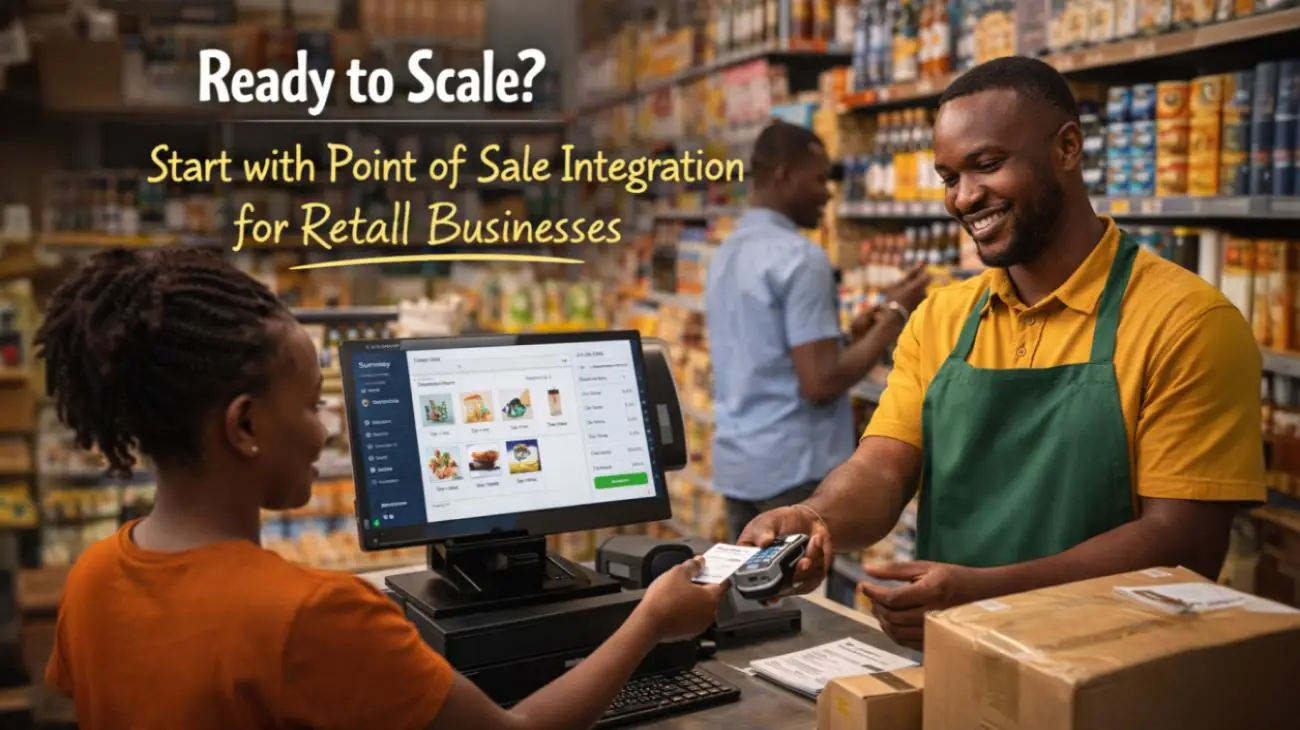
Retail growth often looks exciting from the outside — more stores, higher billing volumes, and expanding product lines. But behind the counters, many businesses quietly struggle with mismatched inventory, delayed financial postings, and scattered sales data. When front-end billing runs separately from back-office systems, the cracks begin to show.
This is exactly where Point of Sale Integration for Retail Businesses becomes a turning point. Instead of juggling disconnected systems, modern retailers are connecting their POS counters directly with ERP platforms to gain real-time visibility and tighter operational control. In this guide, we’ll unpack how Point of Sale Integration works, why it matters for scaling retailers, and how businesses can extract real commercial value from the right implementation.
The Hidden Cost of Disconnected Retail Systems
Many retailers still rely on manual data transfers between POS and ERP systems. At first glance, the process seems manageable. But as transaction volumes grow, the manual effort multiplies — and so do the risks.
Common challenges start appearing delayed stock updates, inconsistent pricing across outlets, reconciliation headaches for finance teams, and limited real-time sales visibility. These issues don’t just create operational friction; they directly affect decision-making speed and customer experience.
With Point-of-Sale Integration for Retail Businesses, these gaps begin to close. Onebit Solution works with retailers who have reached the stage where manual coordination is no longer sustainable and system-driven synchronisation becomes essential.
What is Point of Sale Integration?
Point of Sale Integration connects retail billing systems with ERP platforms so that every sales transaction, inventory movement, and financial posting flows automatically between systems. Instead of waiting for batch uploads or manual entries, the integration pushes data in real time. Sales update inventory instantly. Pricing and tax rules stay aligned across stores. Finance teams receive structured data without chasing reports.
At Onebit Solution, the focus is on building a stable integration layer that supports high transaction volumes while maintaining data accuracy across retail, inventory, and finance functions.
How POS Integration Transforms Retail Operations
When implemented correctly, POS Integration Solutions for Retail Businesses reshape how retail teams operate daily. Store staff spend less time on back-office corrections. Finance teams gain faster visibility. Management gets a clearer view of performance across locations.
The real advantage lies in synchronisation. Every bill generated at the counter immediately reflects in ERP inventory and financial modules. This removes the lag that often causes stock discrepancies and reporting delays.
Onebit Solution typically begins by analysing current POS workflows, identifying data gaps, mapping ERP touchpoints, and then deploying integration in controlled phases to minimise disruption.
Core Capabilities Retailers Should Expect
The Best Point of Sale Integration platforms are designed to handle complexity without slowing down the billing process. Retailers today expect more than simple data transfer — they need consistency, speed, and reliability across all outlets.
A mature integration environment usually includes real-time POS sales synchronisation, automatic inventory updates after each transaction, ERP-driven pricing and tax alignment, multi-store support, finance module integration, and built-in validation controls. Onebit Solution configures these capabilities based on the retailer’s operational model.
This structured approach is why many growing retailers actively look for the Best Point of Sale Integration for Retail Businesses before expanding their store footprint.
Business Benefits of Point-of-Sale Integration for Retail Businesses
Once POS and ERP systems start communicating seamlessly, operational clarity improves noticeably. Retailers gain faster reporting cycles and better stock confidence across locations.
Organisations adopting Point of Sale Integration for Retail Businesses often experience:
- Live sales visibility across all stores
- Accurate, automatic inventory updates
- Faster financial posting and reconciliation
- Reduced manual intervention at store level
- Consistent pricing and taxation across outlets
Onebit Solution focuses on translating these technical improvements into measurable retail performance gains.
Implementation Approach at Onebit Solution
Successful POS Integration Solutions for Retail Businesses depend heavily on disciplined rollout rather than rushed deployment. Retail environments cannot afford billing disruptions, so planning matters.
- POS and ERP landscape assessment
- Integration architecture design
- Controlled pilot rollout
- Multi-store deployment
- Ongoing monitoring and optimisation
This phased method helps retailers adopt the Best Point of Sale Integration with minimal operational risk while maintaining billing continuity.
ROI Perspective for Scaling Retailers
Retail leaders often ask whether POS integration truly impacts the bottom line. In practice, the value appears through faster stock turns, reduced reconciliation effort, improved pricing control, and stronger multi-store visibility.
The Best Point of Sale Integration for Retail Businesses typically pays off by reducing operational friction and supporting confident expansion. However, the actual return depends on store count, transaction volume, and current process maturity.
Onebit Solution works closely with clients to map realistic ROI expectations before implementation begins, helping retailers build a practical and measurable roadmap.
Choosing the Right Integration Partner
Not all integration projects deliver the same results. Retail environments demand both technical expertise and deep understanding of store operations.
The Best Point of Sale Integration providers usually demonstrate strong ERP experience, retail workflow knowledge, and proven multi-store deployment capability. Onebit Solution aligns its delivery model around these priorities, helping businesses move from fragmented systems to unified retail intelligence. Retailers that take time to select the right partner typically experience smoother adoption and stronger long-term stability.
Why Choose us
Choosing the right implementation partner for Point-of-Sale Integration for Retail Businesses can significantly influence retail accuracy, reporting speed, and scalability. Onebit Solution combines ERP expertise with real-world retail understanding to deliver integration frameworks that align with actual store operations. Our team works closely with finance, IT, and retail stakeholders to configure reliable POS Integration Solutions for Retail Businesses that support high transaction volumes and multi-location growth. Rather than offering one-size-fits-all deployments, Onebit Solution builds tailored integration environments designed for long-term retail stability and performance.
Conclusion
Retail expansion brings opportunity, but it also exposes gaps between front-end billing and back-office systems. Point of Sale Integration closes that gap by synchronising sales, inventory, and finance data in real time. Businesses that adopt a structured integration strategy gain clearer visibility, faster reporting cycles, and stronger operational control across stores. The real advantage comes from selecting the right platform and implementation partner. Retailers that modernise their POS ecosystem today position themselves for smoother scaling, better data confidence, and more consistent customer experiences across every outlet.
Ready to scale with Point-of-Sale Integration for Retail Businesses? Contact Onebit Solution at +254 703 789 789 or email info@obsl.co.ke to modernise your retail operations today.
Key Takeaways
- Point of Sale Integration for Retail Businesses improves real-time visibility
- Automated synchronisation reduces manual reconciliation
- The Best Point of Sale Integration supports multi-store growth
- ERP-connected billing improves financial accuracy
- Structured rollout drives faster adoption success
FAQs
What is Point of Sale Integration?
It connects retail billing systems with ERP platforms to automatically synchronise sales, inventory, pricing, and financial data.
Who needs POS Integration Solutions for Retail Businesses?
Retailers with multiple stores or high transaction volumes benefit the most from integrated systems.
Does POS integration update inventory in real time?
Yes, modern integrations update stock levels immediately after each transaction.
Is the Best Point of Sale Integration suitable for multi-store retail?
Yes, it is specifically designed to support multi-location and high-volume retail environments.
How long does POS integration implementation take?
The timeline depends on system complexity and store count but typically follows a phased deployment approach.